Today in therapy, Spirit Canton and I had a discussion about varying value systems and tolerance. Transparency moment: I recently announced I am engaged and plan to become married to my partner. We are a same-sex relationship, and it’s been going great for the past 6 years. I’ve received many congratulatory words of support, but I have also experienced not so happy responses, particularly from my mom who is a devout holiness preacher. She is not supportive of our decision at all. This was expected as I was not expecting anyone to accept our decision, but I knew that she would definitely not support it.
Spirit asked, “If she does not accept your decision, how does that translate to her not accepting you? My answer was simple. I said, “I struggled all of my youth up until the last few years to reconcile my sexuality through work, crying, depression, 10 years as a deliverance minister and so much more. It’s like running a marathon and when you cross the finish line, you won’t allow someone to tell you the last five miles did not count and you are not the winner or at the minimum, a marathon runner. So, I’m left at the table wondering, how do you help a person understand that being gay isn’t a daily choice, but it is who I am and the attraction doesn’t make it important to me, but it’s the years of work and fighting to become okay with myself.”
For my mom, my decision means I am turning my back on God. For me, it means I have overcome many points of heartache from my past. It’s all perspective. She’s willing to lose me for her belief system if I chose that I cannot tolerate her rejection. Now the question becomes how do I tolerate her difference in opinion and should I tolerate it.
My fiance says he’s literally had to fight to get to a place to be okay with himself. Funny, how a lot of people in my community have to go through this. For me, the fight is a major part of who I have become. When a person rejects a core part of that fight and suggests that what you have become is not real, then how is it not a rejection of who you are? I show tolerance in my own desire to receive tolerance from others. It’s a balancing act that I chose to do. Although I have had to fight to understand and accept myself better, I always understand that no one else is obligated to understand and accept me themselves, especially religious people. Do I give them a pass? Maybe I do. The reason I do is because what is the point in two people beating up on each other using the same bat? No one’s perspective is right. It is right for the person who holds it, but it’s not right to put it on someone else.
Be Tolerant by Isolating Perspectives
You become more tolerant by knowing how to isolate perspectives. For me, I chose not to be combative with my mom, although she was clearly combative with me. She called it standing on the Word of God. I call it ineffective ministry. That’s a post for another day. I understood that her perspective is very fundamental and that we hold two very different set of values. My values are based on years of defining myself, also coupled with 10 years as a preacher and a degree in theology. For me, the processing of the situation is different, but does that give me the right to reject her because she believes differently? No, it doesn’t. But it also does not give her the right to do it either. As long as we both exercise tolerance, then we will be okay.
Isolating perspectives is important so that you can remain confident in your position without feeling that someone or something that does not agree is a threat. If you believe that your perspective should be everyone’s perspective, then you are not ready nor capable to be a tolerant person. There will always be division.
Your values are yours. The cashier down at Costco has her own set of values. Everyone has their own set of values. Who are we to tell someone else that their life experiences and the values they have gathered from those experiences are invalid? This is where the issue with homosexuality and family dynamics come to play. The problem is many base their values on religion which is good in its proper context. However, some do not define their existence based on religion. Some understand that faith happens inside and outside of the confines of religion. A lot of perspectives are situated on a set of values and we should not reject, punish and demean others because they perceive their existence in the world differently, considering that how they exist in the world is not harming others.
The 1.2.3. on being Tolerant
- Why Fight? Perhaps it’s so you can be heard or you feel like you are not being understood. Remember it’s no one’s job to understand you. Obtaining tolerance of another person’s point of view doesn’t always mean you have to agree. It just means you have heard them out.
- No Pain, no Gain. This means something has to hurt to get something positive out of it, but who says you have to hurt others to get them to accept your point of view? If your perspective and the way you deliver it is hurtful, then you should reconsider what you are doing. This is not a subliminal note for my Mom, but I use my experiences as teaching moments to coach others in their various places in life. My point is, you don’t have to cause pain to gain understanding between two parties. Likewise, you don’t have to cause pain to tell someone you don’t agree with them. So that means, stop cutting people off because they are gay, or white, or interracially married.
- Agree to Disagree…and mean it! I’ve never really liked the idea of agreeing to disagree because I’ve never fully believed that two people who don’t agree can mutually coexist in peace without there being some type of intolerance. I’m now learning that they can if they choose to be tolerant. This means I don’t agree with my Mom’s hell, fire and brimstone stance about my life, but I don’t have to take it personally. From there, I can choose to agree to disagree without malice or agree to disagree with a grudge. But if you truly agree to disagree, the point is to exercise tolerance for having a different set of values about something. That doesn’t mean that we have to end our relationship because we don’t see eye to eye. Now there are times where you do have to back away if a person is mistreating you or saying hurtful things to and about you. But, to be tolerant is to learn how to continue relationships with people who don’t necessarily believe the same way that you do.
Be Tolerant – It’s Not Rocket Science
I recognize that for some, being tolerant is an ego issue. Some people are not able to step outside of themselves. They won’t step outside of their silos to be tolerant of someone who eats differently, or believes differently or is gay. They may reject blacks, whites, Muslims and so many other things. Consider this: Why does the world tell us that we have to belong to groups? We do it everywhere. We have football teams and take sides and shout, “My team is better than yours.”
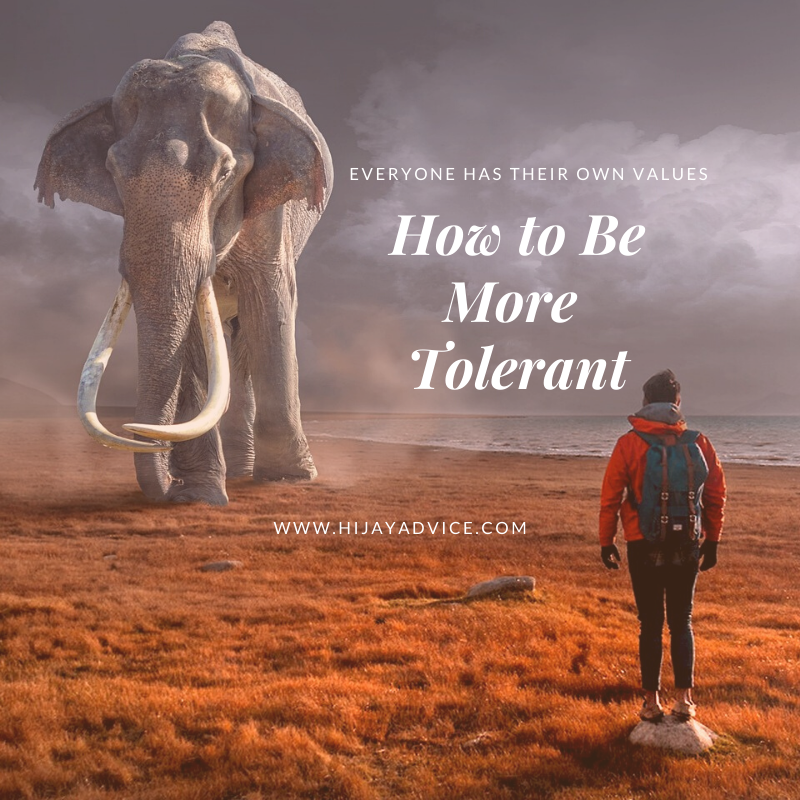
Notice how groups tend to create conflict with those groups who don’t share their values. While there is nothing wrong with having groups with different sets of values, you must learn that everyone is not touching the elephant at the same place. When considering if my perspective on something is more valuable than yours, think of an elephant and a set of toddlers. One toddler in the front get’s to witness the massive trunk. Another toddler on the side gets to witness the bulging belly. Then, another toddler in the back gets to witness the tiny tail of the elephant. If they could talk about their perspectives, they would all describe something different, but at the end of the day, they are talking about the same elephant. I leave you with that to ponder that just because someone is experiencing life from a different place with a different past, that doesn’t mean that the values they’ve developed are wrong.